MM Algorithms
Definition
Majorization-Minimization (MM) is an important concept in optimization. It is more of a principle than a specific algorithm, and many algorithms can be interpreted under the MM framework (coordinate descent, proximal gradient method, EM Algorithm, etc.). The main idea is the concept of a majorizing function.
A Function \(h(\theta)\) is said to majorize \(f(\theta)\) at \(\theta^{(t)}\) if
\[ \begin{aligned} h(\theta | \theta^{(t)}) &\ge f(\theta | \theta^{(t)}) \quad\text{(dominance condition)}, \\ h(\theta^{(t)} | \theta^{(t)}) &= f(\theta^{(t)} | \theta^{(t)}) \quad\text{(tangent condition)}. \end{aligned} \]
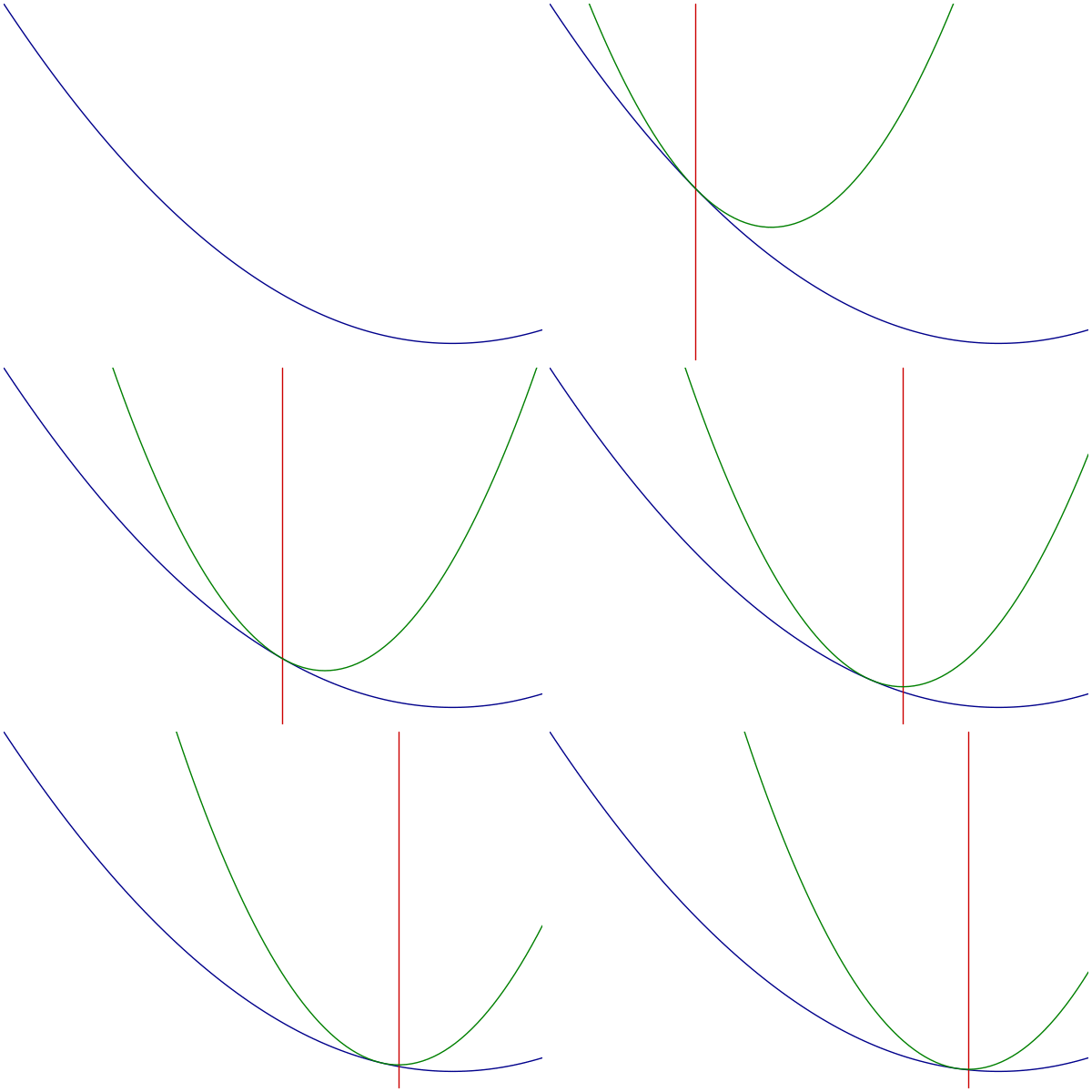
Simply put, the surface of \(h(\theta)\) lies above \(f(\theta)\), apart from at \(\theta^{(t)}\) where they are equal. An MM update consists of minimizing the majorization:
\[\theta^{(t+1)} = \text{argmin}_\theta \;h(\theta|\theta^{(t)}).\]
Things to note:
- MM updates are guaranteed to decrease the value of the objective function (descent property).
- Majorizations are often used to split parameters, allowing updates to be done element-wise.
Visualization
- Blue: Objective
- Green: Majorization
- Red: Parameter Estimate
Example: Logistic Regression
Majorization
One technique for majorizing a convex function is a quadratic upper bound. If we can find a matrix \(M\) such that \(M - d^2f(\theta)\) is nonnegative definite for all \(\theta\), then
\[f(\theta) \le f(\theta^{(t)}) + \nabla f(\theta^{(t)})^T(\theta - \theta^{(t)}) + \frac{1}{2}(\theta - \theta^{(t)})^T M (\theta - \theta^{(t)}).\]
Using the RHS as our majorization, updates take the form
\[\theta^{(t+1)} = \theta^{(t)} - M^{-1}\nabla f(\theta^{(t)}).\]
This method produces an update rule that looks like Newton’s method, but uses an approximation of the Hessian which guarantees descent.
Logistic Regression
The negative log-likelihood for the logistic regression model provides the components
\[ \begin{aligned} f(\beta) &= \sum_i \left\{-y_i x_i^T\beta + \ln\left[1 + \exp(x_i^T\beta)\right]\right\} \\ \nabla f(\beta) &= \sum_i -[y_i - \hat{y_i}(\beta)]x_i \\ d^2 f(\beta) &= \sum_i \hat{y_i}(\beta)[1 - \hat{y_i}(\beta)]x_i x_i^T \end{aligned} \]
where each \(x_i\) is a vector of predictors, \(y_i\in\{0, 1\}\) is the response, and \(\hat{y_i}(\beta) = (1 + \exp(-x_i^T\beta))^{-1}\). Continuing to create the majorization:
- In matrix form, the Hessian is \(d^2 f(\beta) = X^TWX\), where \(W\) is a diagonal matrix with entries \(\hat{y_i}(1 - \hat{y_i})\).
- \(\hat{y_i}\) can only take values in (0, 1), so \(\frac{1}{4} \ge \hat{y_i}(1 - \hat{y_i})\).
- Therefore, we can use \(M = X^TX/4\) to create a quadratic upper bound. Compare this MM update to Newton’s method.
MM Updates
\[ \beta^{(t+1)} = \beta^{(t)} - 4\left(X^TX\right)^{-1}X^T(y - \hat{y}(\beta^{(t)})) \]
Newton Updates
\[ \beta^{(t+1)} = \beta^{(t)} - \left(X^TWX\right)^{-1}X^T(y - \hat{y}(\beta^{(t)})) \]
In this case, MM has the advantage of being able to reuse \((X^TX)^{-1}\) after it is computed once, whereas Newton’s method must solve a linear system at each iteration.